• Skip to primary navigation
  • Skip to main content
  • Skip to primary sidebar

Cosmic Pursuits

Basic astronomy and night sky information

  • Subscribe
  • Start Here
  • Articles
  • Sky This Month
  • Courses
  • About
  • Contact

Deep Sky Observing

Articles about how to understand, find, and see celestial objects including stars, galaxies, nebulae, and star clusters with binoculars, telescopes, and the naked eye.

Faint Fuzzies in and Around Pegasus and Andromeda

December 23, 2019 by Joe Bergeron Filed Under: Deep Sky

The globular cluster M15 in the constellation Pegasus.
Image credit: Joe Bergeron.

I write this in late October. Every night, the sky is four minutes more wintry than it was the night before. For now, the sky is still dominated by the constellations most associated with Autumn, even as the Summer Triangle slides past the meridian and the Pleiades rise in the east.

The constellations of northern autumn, Pegasus and Andromeda, linger well into the winter months and offer many deep sky wonders for observers equipped with a good telescope. One recent autumn evening, as the Pleiades rose in the east, I set about looking for a handful of these sights in my 8-inch Edge HD Schmidt-Cassegrain telescope [Read more…] about Faint Fuzzies in and Around Pegasus and Andromeda

Share This:
Facebooktwitterredditpinterestlinkedinmail

Filed Under: Deep Sky

A Low-Power Romp in the Late-Summer Sky

September 13, 2019 by Joe Bergeron Filed Under: Deep Sky

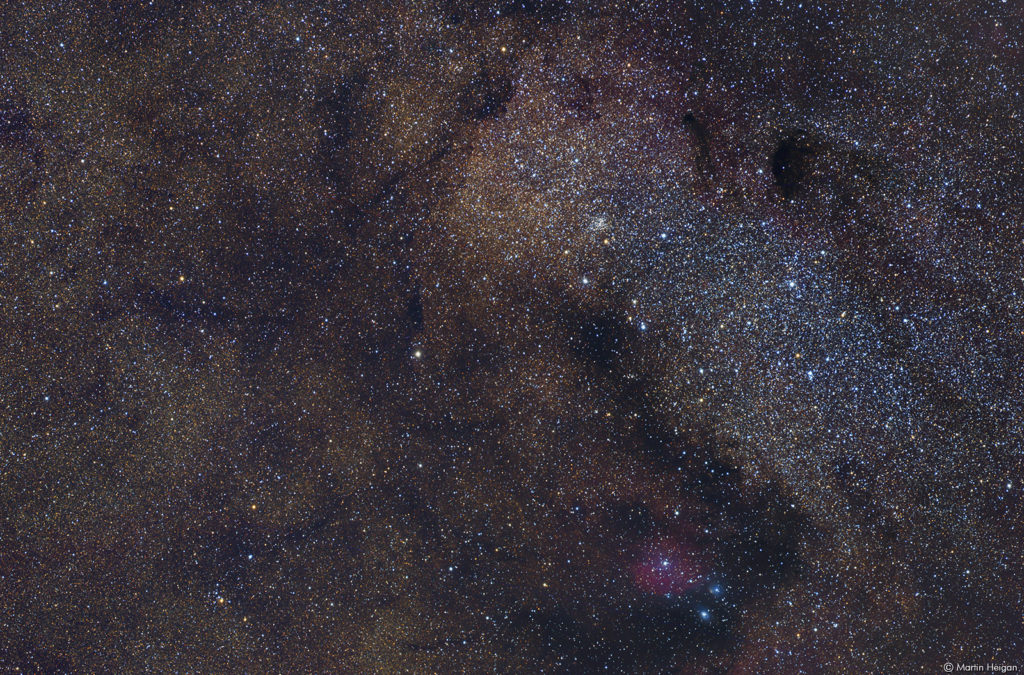
Messier 24, the Small Sagittarius Star Cloud, at right. Image credit: Martin Heigen/Flickr.

Let’s follow last week’s sky tour with a pair of objects where low power is so essential that without it, you might miss them entirely. The first is the open cluster IC 4665, which lies a degree or two north of the star Beta Ophiuchi (Cebalrai). The cluster was “discovered” by astronomer after astronomer, but it didn’t make enough of an impression on anyone to stick around in the astronomical consciousness until it was finally added to the Index Catalog in 1908. In my little telescope at 18x I see a very scattered group of twenty or so easily seen stars spreading across a degree or more of sky. Try as I might, I could not imagine a compelling picture in this random assortment of star dots. Surrounding the most nearly crowded part of the cluster are a few more isolated pairs and individual stars that give the impression of being cluster members. This might be a better object for binoculars than for any telescope. [Read more…] about A Low-Power Romp in the Late-Summer Sky

Share This:
Facebooktwitterredditpinterestlinkedinmail

Filed Under: Deep Sky

Deep Sky Tour: Nebulae in Cygnus

September 7, 2019 by Joe Bergeron Filed Under: Deep Sky

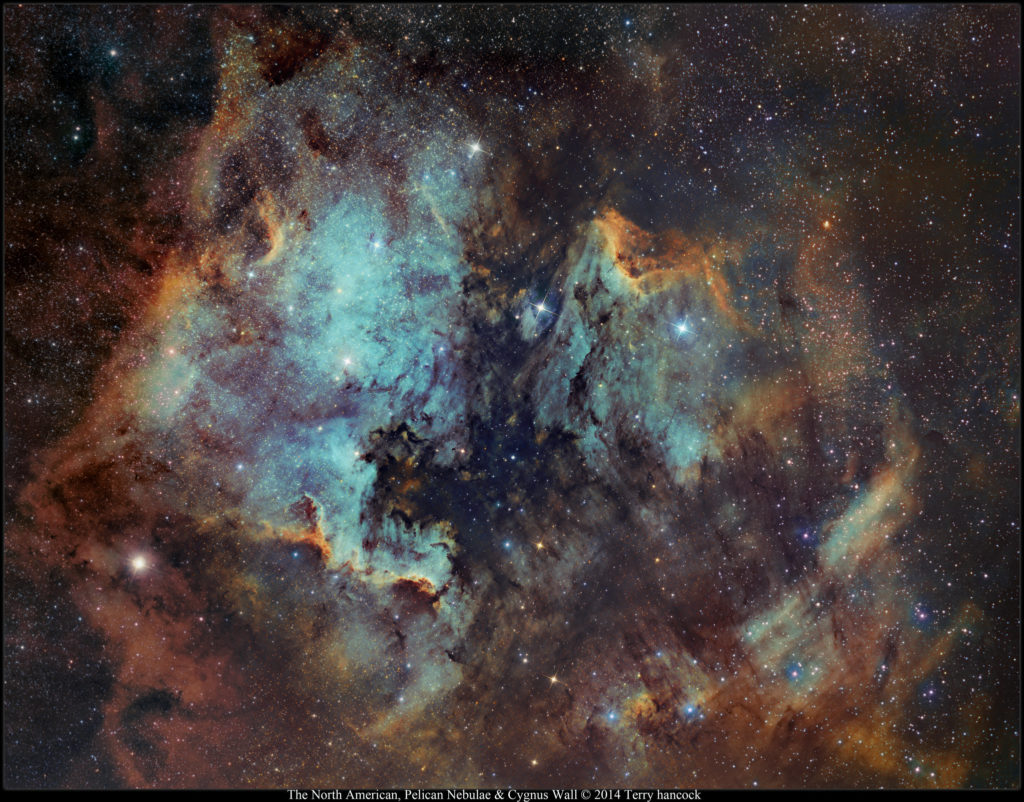
The North America Nebula (left) and the Pelican Nebula (right). Image credit: Terry Hancock via Flickr.

In my previous sky tour, I talked up the virtues of observing deep sky objects using fairly high magnifications with a reasonably big 8-inch f/10 telescope. This time around, let’s veer to the opposite extreme and take a tour of a series of celestial objects that are best seen using small telescopes, low magnifications, and wide fields of view.

Cygnus, the Swan, which is as emblematic of northern-hemisphere summer as any other constellation, holds two of the best examples of wide-field objects which are visible nearly overhead in late northern summer, and low over the northern horizon for southern-hemisphere observers [Read more…] about Deep Sky Tour: Nebulae in Cygnus

Share This:
Facebooktwitterredditpinterestlinkedinmail

Filed Under: Deep Sky cygnus, veil nebula

High-Power Hercules

July 11, 2019 by Joe Bergeron Filed Under: Deep Sky

The globular cluster Messier 13 in the constellation Hercules. The far more distant galaxy NGC6207 is at lower left. Image credit: Roth Ritter.

When sight-seeing larger nebulae (like the North America Nebula) and big star clusters (like the Double Cluster or Beehive), it’s usually best to stick with lower magnification and wider fields of view to take in the entire object. But most deep sky objects benefit from greater magnification, sometimes much greater. To demonstrate this, I prowled around in the constellation of Hercules, using my 8-inch Celestron Edge HD scope and an 8mm eyepiece, giving a magnification of 250x.

The first object on my tour was the planetary nebula NGC 6210. Like many planetaries, it has a high surface brightness that enables it to bear high magnifications well. At low powers it looks like a tiny bluish dot. 250x brings out considerable visual character in this 16 arc second object. Slightly oval, its edges are diffuse. Colorful as many planetaries are, it shows an aqua tint with hints and flashes of a fierce electric blue. I found that an 8-inch scope isn’t quite big enough to show these colors strongly in this particular object, but a 12-inch or larger instrument will make them unmistakable, and then you’re viewing an exotic object indeed. I did not consistently see the nebula’s central star, though this should not be difficult at magnitude 12.7. This may be due to the consistently rough seeing I experience in this valley of the southern Sierra Nevada range, where I’m surrounded by mountains on all sides. This tends to muddle the faint star into the bright glow of the nebula.

[Read more…] about High-Power Hercules

Share This:
Facebooktwitterredditpinterestlinkedinmail

Filed Under: Deep Sky globular cluster, hercules, m13

Careening Through Carina

April 24, 2019 by Joe Bergeron Filed Under: Deep Sky

The star cluster NGC 2516 in the constellation Carina. Image credit: Sergio Equivar.

In dark sky, northern-hemisphere observers can see the winter Milky Way as a featureless, inconspicuous band of haze running east of Orion and disappearing below the horizon south of the constellations Canis Major and Puppis. In light-polluted sky, the winter Milky Way is hard to see at all. But further south, into the far southern constellation Carina, the Milky Way suddenly explodes into one of its brightest, most spectacular, and most detailed sections, running through Crux, Centaurus, and beyond [Read more…] about Careening Through Carina

Share This:
Facebooktwitterredditpinterestlinkedinmail

Filed Under: Deep Sky

  • « Go to Previous Page
  • Go to page 1
  • Interim pages omitted …
  • Go to page 7
  • Go to page 8
  • Go to page 9
  • Go to page 10
  • Go to page 11
  • Interim pages omitted …
  • Go to page 21
  • Go to Next Page »

Primary Sidebar

Subscribe to Cosmic Pursuits

Subscribe to our e-mail newsletter for free astronomy tips and updates

Featured Astronomy Course


Search This Site

Recent Posts

  • IC 4665, the “HI” Star Cluster
  • Noctilucent Clouds – Marvels of the Mesosphere
  • Hopping Galaxies in the Bear’s Den
  • A Dazzling New View of the Sombrero Galaxy
  • NEAF 2026 Overview and Recap

Copyright © 2026 Mintaka Publishing Inc.