• Skip to primary navigation
  • Skip to main content
  • Skip to primary sidebar

Cosmic Pursuits

Basic astronomy and night sky information

  • Subscribe
  • Start Here
  • Articles
  • Sky This Month
  • Courses
  • About
  • Contact

Deep Sky Observing

Articles about how to understand, find, and see celestial objects including stars, galaxies, nebulae, and star clusters with binoculars, telescopes, and the naked eye.

The ‘Seven (Dusty) Sisters’

January 18, 2019 by Brian Ventrudo Filed Under: Deep Sky

An image of the Pleiades Star Cluster (Messier 45) and surrounding region. Image courtesy of Terry Hancock and Grand Mesa Observatory.

Like many observers both casual and serious, I do not tire of gazing upon the little star cluster known as the Pleiades. I’ve seen the cluster a thousand times, but I’ll still stop and take a long look at it without optics while out for a walk on a winter’s night. Some night I’ll grab a pair of binoculars and make a closer inspection of the cluster, which fits perfectly in the field of view of such an instrument. And if it’s not too cold, I’ll pull out a telescope and a wide-field eyepiece and spend 20 minutes taking in the astonishing view of this group of blue-white stars that formed while dinosaurs still roamed the Earth. Which, in celestial terms, was not all that long ago.

Why keep looking at the Pleiades after so many years? The cluster doesn’t appear to change, of course, in the restricted timescale of a human life. But the Pleiades is a profoundly beautiful sight, as pleasing as a field of alpine wildflowers, and I never fail to see new patterns of stars both bright and dim that I hadn’t noticed before [Read more…] about The ‘Seven (Dusty) Sisters’

Share This:
Facebooktwitterredditpinterestlinkedinmail

Filed Under: Deep Sky astrophotography, pleiades, taurus

The Lonely Star of Autumn

December 7, 2018 by Brian Ventrudo Filed Under: Deep Sky

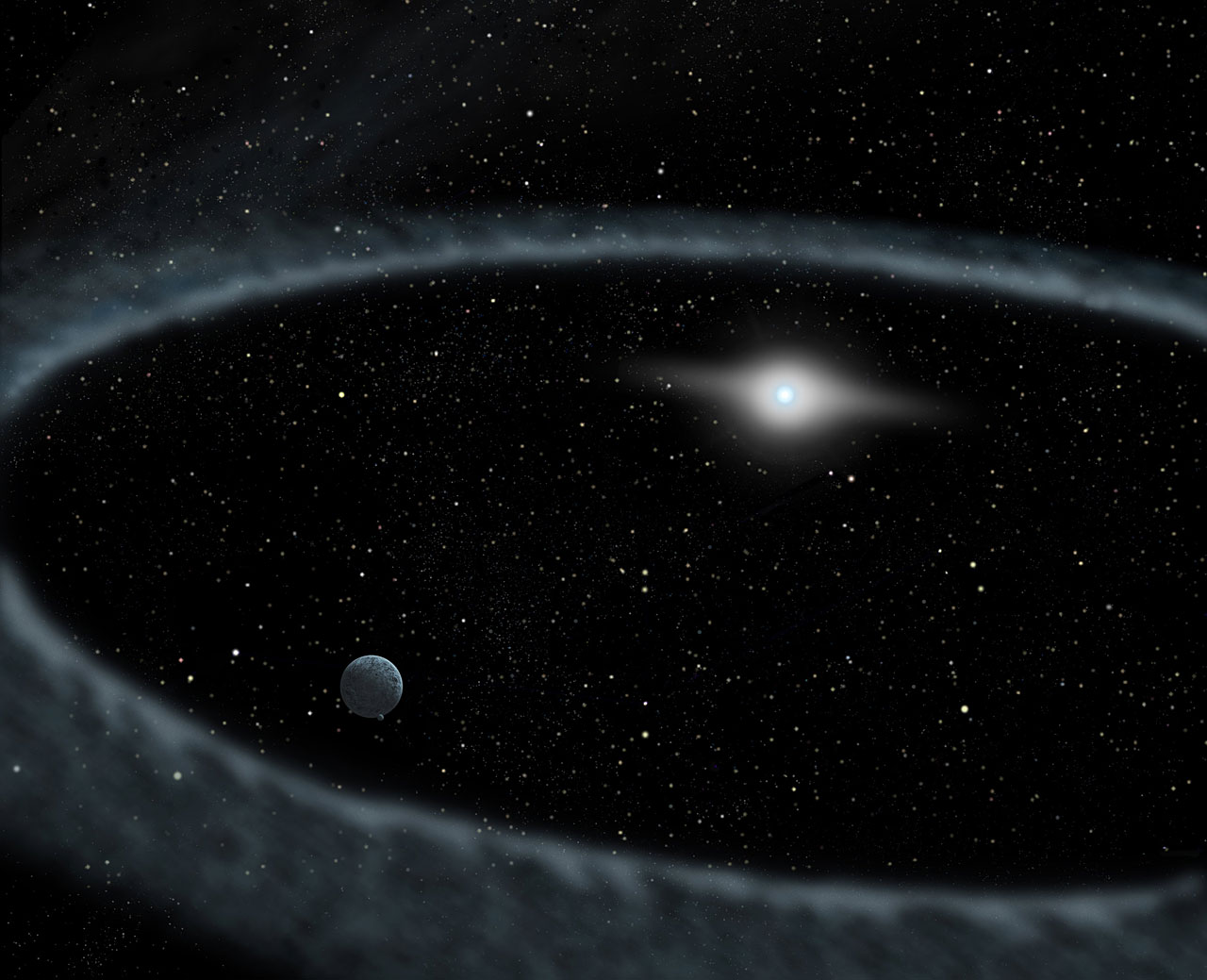
This illustration shows a ring of debris encircling the star Fomalhaut. A suspected planet is orbiting inside the ring. Credit: NASA, ESA and A. Feild (STScI)

In the vast expanse of sky between the brilliant stars Antares in the west and Sirius in the east, there lies but a single bright star of note, the star Fomalhaut. Low and prominent over the southern horizon, this lovely white star is a lonely sight on a northern fall evening. Fomalhaut marks the mouth of the constellation Piscis Austrinus (the Southern Fish).  The star is a pretty enough sight for casual stargazers this time of year, and it offers a very widely spaced companion that’s easy to see in binoculars. The star also hosts at least one ring of glowing dust and debris left over from its birth. And where there’s dust, there may very well be planets… [Read more…] about The Lonely Star of Autumn

Share This:
Facebooktwitterredditpinterestlinkedinmail

Filed Under: Deep Sky

The Cat’s Eye Nebula

November 8, 2018 by Brian Ventrudo Filed Under: Deep Sky

An image of the Cat’s Eye Nebula captured with the Hubble Space Telescope. Image credit: NASA.

Unlike galaxies and star clusters and even emission nebulae, the class of objects known as planetary nebulae exist on a scale of space and time that’s comprehensible, relevant, and compelling to most humans.

Comprehensible because these tenuous exhalations of dying stars are roughly the size of a solar system, which means light can pass from one end of the nebula to the other in just a few hours, and even our current spacecraft could cross some of these nebulae in a matter of years.

Relevant because our own Sun will expire after creating its own planetary nebula in a few billion years when our star’s inner core boils off its outer layers in an intermittent nuclear frenzy.

And compelling because as you observe these objects with your telescope, you may be witnessing the death of other solar systems which once harbored intelligent civilizations that long ago passed into oblivion, or perhaps learned to travel elsewhere in the galaxy before it was too late. Amateur astronomy is, after all, a pastime of the imagination [Read more…] about The Cat’s Eye Nebula

Share This:
Facebooktwitterredditpinterestlinkedinmail

Filed Under: Deep Sky

A Speedy Little Double Star

September 6, 2018 by Brian Ventrudo Filed Under: Deep Sky

An image of 70 Ophiuchi by Damian Peach.

When it comes to observing the stars and other sights beyond our solar system, there’s always something new to see. But once you see it, chances are it’s not going to chance much in the coming years. That’s because things move slowly in the cosmos, at least compared to a human lifetime.

There are, however, a few exceptions. One of the most important for astronomers is the nearby binary star called 70 Ophiuchi, a little gem in the asterism known as Taurus Poniatowski in the constellation Ophiuchus. It’s a beautiful star for casual stargazers armed with a small telescope. Serious stargazers can watch over the course of a year or two to detect the motion of the two components as they slowly revolve around each other during their 88-year period. It’s one of the few double stars that make a complete revolution within the course of a human lifetime [Read more…] about A Speedy Little Double Star

Share This:
Facebooktwitterredditpinterestlinkedinmail

Filed Under: Deep Sky

The Blue-Green Beauty of Planetary Nebulae

May 16, 2018 by Joe Bergeron Filed Under: Deep Sky

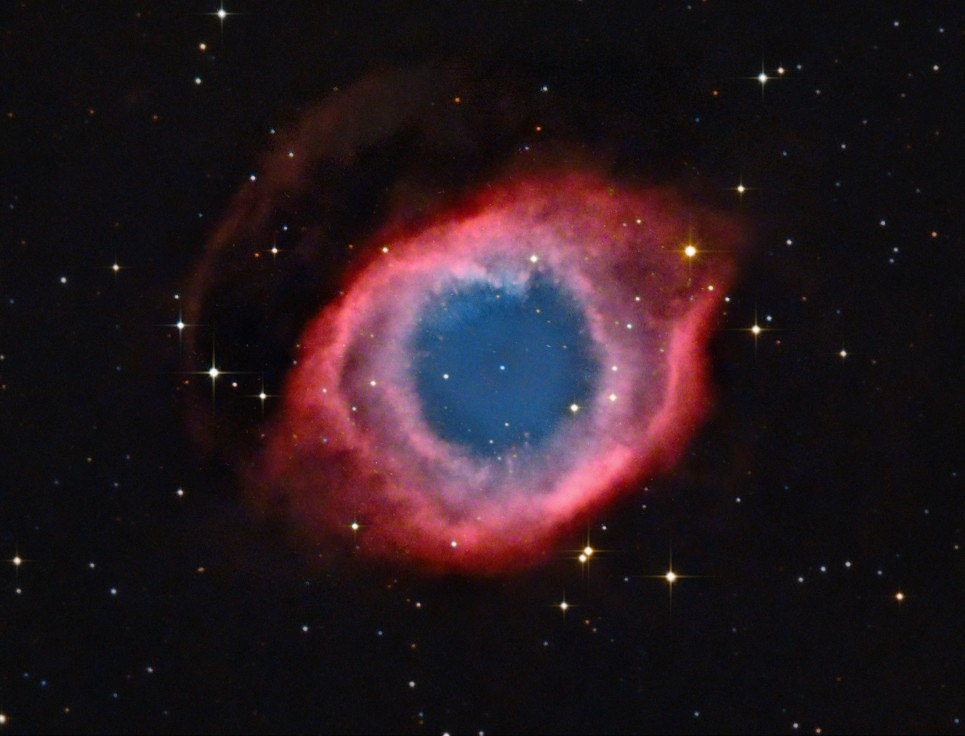
A long-exposure image of the Helix Nebula (NGC 7293) shows far more color than can be observed visually, even through a large telescope. Image credit: Terry Hancock.

New and would-be amateur astronomers are often mystified and disappointed by the lack of color in things they see through their telescopes. And why shouldn’t they be? Popular astronomy shows, magazines, and web sites encourage people to believe that celestial objects are rich with blistering, saturated color, much like the image above. Why doesn’t that new $400 8-inch Dobsonian show bright pink nebulae, and galaxies of blue and gold? [Read more…] about The Blue-Green Beauty of Planetary Nebulae

Share This:
Facebooktwitterredditpinterestlinkedinmail

Filed Under: Deep Sky carbon stars, planetary nebula

  • « Go to Previous Page
  • Go to page 1
  • Interim pages omitted …
  • Go to page 9
  • Go to page 10
  • Go to page 11
  • Go to page 12
  • Go to page 13
  • Interim pages omitted …
  • Go to page 21
  • Go to Next Page »

Primary Sidebar

Subscribe to Cosmic Pursuits

Subscribe to our e-mail newsletter for free astronomy tips and updates

Featured Astronomy Course


Search This Site

Recent Posts

  • Where is Amateur Astronomy Going?
  • Contemplating the “Harp Star”
  • Touring the Tiny Constellations of Summer
  • IC 4665, the “HI” Star Cluster
  • Noctilucent Clouds – Marvels of the Mesosphere

Copyright © 2026 Mintaka Publishing Inc.