• Skip to primary navigation
  • Skip to main content
  • Skip to primary sidebar

Cosmic Pursuits

Basic astronomy and night sky information

  • Subscribe
  • Start Here
  • Articles
  • Sky This Month
  • Courses
  • About
  • Contact

Brian Ventrudo

About Brian Ventrudo

Brian Ventrudo is a lifelong stargazer, writer, former scientist, and the publisher of Cosmic Pursuits.

If You Could Have Only One Refractor…

January 31, 2026 by Brian Ventrudo Filed Under: Astronomy Equipment

While big-aperture reflectors have their place for visual observing and astro-imaging, it’s hard to beat the view through a good apochromatic or ED refractor. The pinpoint stars, the superb contrast, and relative ease of use make this scopes extremely popular among amateur astronomers.

But what is the best refractor? Or to put it a different way, if you could choose only one refractor, which would it be? For me, it’s my Tele Vue 85mm – what the late Al Nagler called the ‘goldilocks’ telescope because it’s just right for nearly everything. In the video above, Ed Ting takes a personal view of which refractor he would choose if he could have only one (hint – it’s made in Japan).


Share This:
Facebooktwitterredditpinterestlinkedinmail

Filed Under: Astronomy Equipment

Observing Stars, From Birth to Death

January 31, 2026 by Brian Ventrudo Filed Under: Science, Stargazing

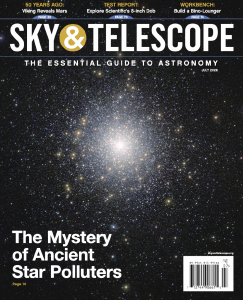
In my latest article in Sky & Telescope magazine, we take a tour of sights along the northern Milky Way that highlight some key phases of a star’s life, both large, massive stars that burn hot and die young, as well as smaller, average-size stars like our Sun that live more stable, measured lives. Along the way, we see some spectacular sights for a small telescope for visual observing or astrophotography.

Click on the thumbnail to read the article (PDF format, 8MB).


Share This:
Facebooktwitterredditpinterestlinkedinmail

Filed Under: Science, Stargazing

Have Astronomers Finally Discovered the First Stars?

January 15, 2026 by Brian Ventrudo Filed Under: Science

The first stars were big, bright, and burned out only a few million years after their formation. These stars formed out of nearly pure hydrogen and helium with no traces of heavier elements like iron and sodium found in later generation of stars, since these elements formed in nuclear reactions in the first stars themselves. None of these primordial ‘Population III’ stars exist in the local universe since they long ago exploded as supernovae. But astronomers have been searching for these first stars in distant galaxies that formed long ago. For the first time, a team of researchers have found the first signatures of these stars in a small galaxy observed with the JWST (and with the help of gravitational lensing by an intervening galaxy cluster). Neil deGrasse Tyson explains the what they found in the above video.

If you’re keen on learning more about the first stars, have a look at my feature article about stellar archaeology and the first stars published in Sky & Telescope magazine in June 2020 at this link.

Share This:
Facebooktwitterredditpinterestlinkedinmail

Filed Under: Science

A Guide to Observing Jupiter in 2026

January 1, 2026 by Brian Ventrudo Filed Under: Solar System

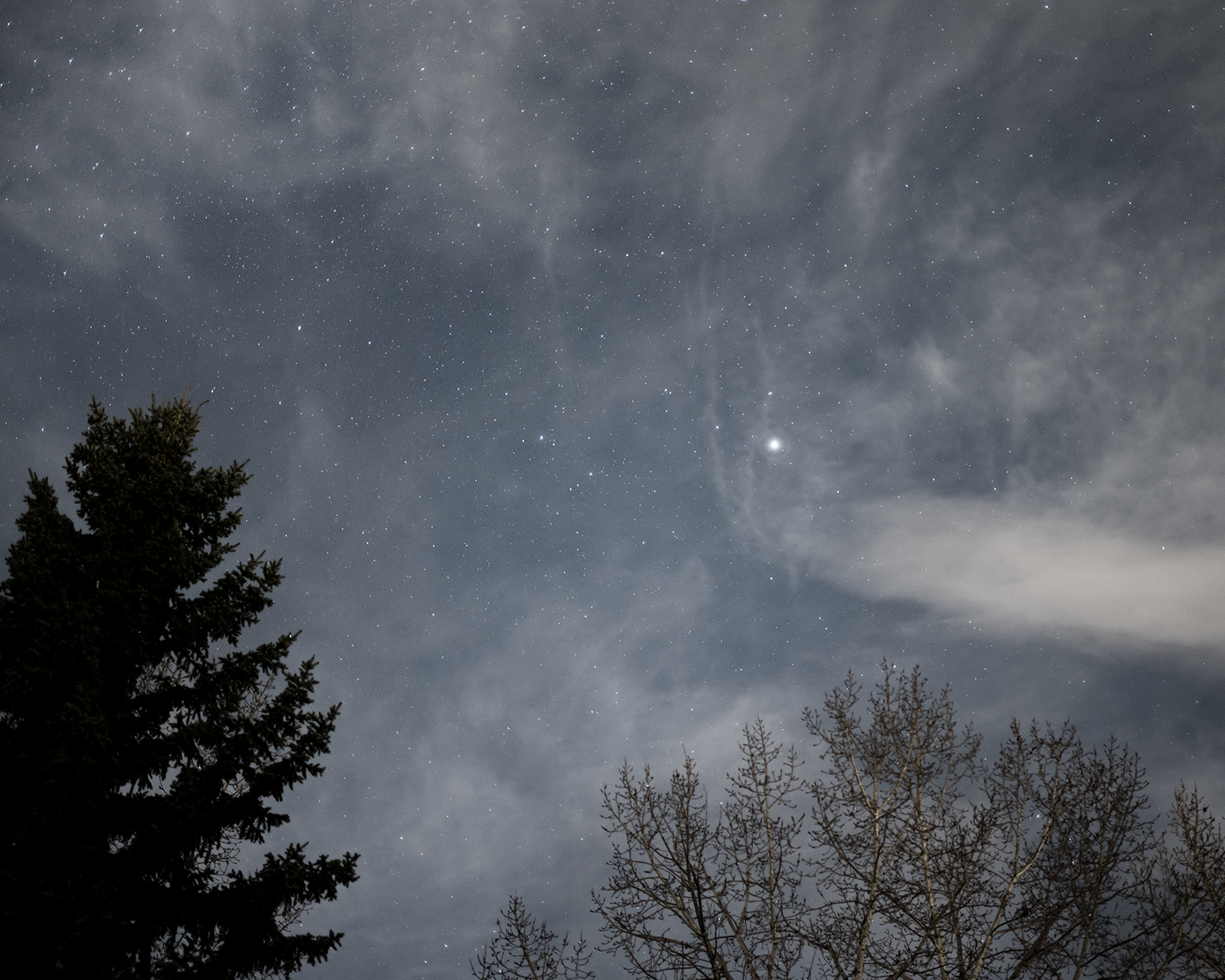
The planet Jupiter is always one of the brightest objects in the night sky. It’s brighter than any star, and is only outshone by the planet Venus and the Moon, and, very rarely, by Mars and Mercury (when it’s too close to the Sun to observe). Jupiter reaches a position for optimum viewing in a telescope once every 13 months, roughly, and it makes its latest closest approach to Earth on January 10, 2026 at 09h Universal Time when the planet appears near Castor and Pollux in Gemini. Several months before and after this date, Jupiter is in perfect position for viewing with a small telescope, or even a pair of binoculars. You can’t miss it: the planet is by far the brightest object in the eastern sky as night gets underway in the northern hemisphere from now through mid-2026. The visible face of Jupiter reveals so many interesting features in a small telescope that the planet is a favorite target for new and experienced stargazers [Read more…] about A Guide to Observing Jupiter in 2026

Share This:
Facebooktwitterredditpinterestlinkedinmail

Filed Under: Solar System jupiter, observing guide

The Rosette Nebula

December 28, 2025 by Brian Ventrudo Filed Under: Deep Sky

The heart of the Rosette Nebula and the open cluster NGC 2244 that is emerging from it. Captured with a ZWO Seestar S50 telescope.

Look to the east of mighty Orion and you’ll see the constellation Monoceros, the Unicorn. While its stars are faint, Monoceros holds a small treasure chest of superb deep-sky sights for backyard stargazers. Perhaps the most striking is the Rosette Nebula, an achingly beautiful blossom of glowing gas and dust where new stars are forming.  The Rosette is an immense nebula, some three times larger than the Orion Nebula and three times farther away.  As you see in the image above, captured with a little ZWO smart telescope, the nebula overlaps the star cluster NGC 2244 which formed within the nebula and blown a bubble to give us a look inside. While can be a challenge to see the Rosette visually, even in large telescopes, the nebula is an excellent photographic target and the cluster offers a superb sight in binoculars or a telescope [Read more…] about The Rosette Nebula

Share This:
Facebooktwitterredditpinterestlinkedinmail

Filed Under: Deep Sky nebula, rosette, sky tour

  • Go to page 1
  • Go to page 2
  • Go to page 3
  • Interim pages omitted …
  • Go to page 78
  • Go to Next Page »

Primary Sidebar

Subscribe to Cosmic Pursuits

Subscribe to our e-mail newsletter for free astronomy tips and updates

Featured Astronomy Course


Search This Site

Recent Posts

  • If You Could Have Only One Refractor…
  • Observing Stars, From Birth to Death
  • Have Astronomers Finally Discovered the First Stars?
  • A Guide to Observing Jupiter in 2026
  • The Rosette Nebula

Copyright © 2026 Mintaka Publishing Inc.