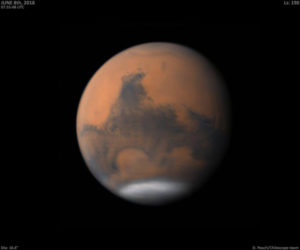
The planet Mars is one of the most interesting planets to observe with a small telescope, but also one of the most difficult. The planet only gets close enough to Earth to give up much detail just once every 780 days (about two years and two months), and when it does make an apparition, it still appears relatively small compared to Jupiter or Saturn. But observing Mars is worth the effort. It’s the only planet to reveal an appreciable amount of surface detail in a small telescope, and it also features occasional surprises such as dust storms and local fogs and cloud banks.
Seeing Mars takes a little practice, however, as well as the right tools for the job. This guide will help you understand what you can see on the surface of Mars, especially near the opposition of January 15-16, 2025. And it will help you get the best view of this remarkable world with a telescope and a few essential accessories [Read more…] about Guide to Observing Mars in 2025
Share This:


 Many casual observers get hooked on amateur astronomy after a first look at Saturn through a telescope. More than a few have looked through my small refractor on a night of good seeing and asked of Saturn, “Is it real?” Yes, it is real. And it’s one of the most beautiful things you will ever see. The color of Saturn, the proportions, the apparent 3D perspective of this grand icy world make it arguably the finest sight accessible with a small telescope. The planet reaches opposition on June 27, 2018 and will remain bright and large in a telescope over the next few months. Here’s how to find it and see it in a small telescope.


