• Skip to primary navigation
  • Skip to main content
  • Skip to primary sidebar

Cosmic Pursuits

Basic astronomy and night sky information

  • Subscribe
  • Start Here
  • Articles
  • Sky This Month
  • Courses
  • About
  • Contact

Joe Bergeron

About Joe Bergeron

Joe Bergeron is an amateur astronomer of 50 years experience, a former planetarium director, a space artist, and the author of ten novels. See more of Joe's work at www.joebergeron.com.

Hopping Galaxies in the Bear’s Den

April 29, 2026 by Joe Bergeron Filed Under: Deep Sky

The galaxies M82 (lower left) and M81 in the constellation Ursa Major. Image credit: Joe Bergeron.

So many galaxies, so little time! A good place to begin an evening of galaxy hopping on a northern spring or summer night is with the Messier galaxies M81 and M82 in the constellation Ursa Major (see above). Conveniently located by drawing a line through the Big Dipper stars Phecda and Dubhe and extending it an equal distance beyond the Big Dipper asterism, this is probably the finest galaxy pair in the sky. Separated by just 38 arc-minutes, both fit into the low power field of a small telescope. With a 22mm Panoptic eyepiece in my 8″ EdgeHD telescope, I had 93x and a field of view of 45 arc minutes, so I had to slew the mount a little from one to the other to see them both well [Read more…] about Hopping Galaxies in the Bear’s Den

Share This:
Facebooktwitterredditpinterestlinkedinmail

Filed Under: Deep Sky

An Ode to Small Telescopes

April 2, 2023 by Joe Bergeron Filed Under: Astronomy Equipment

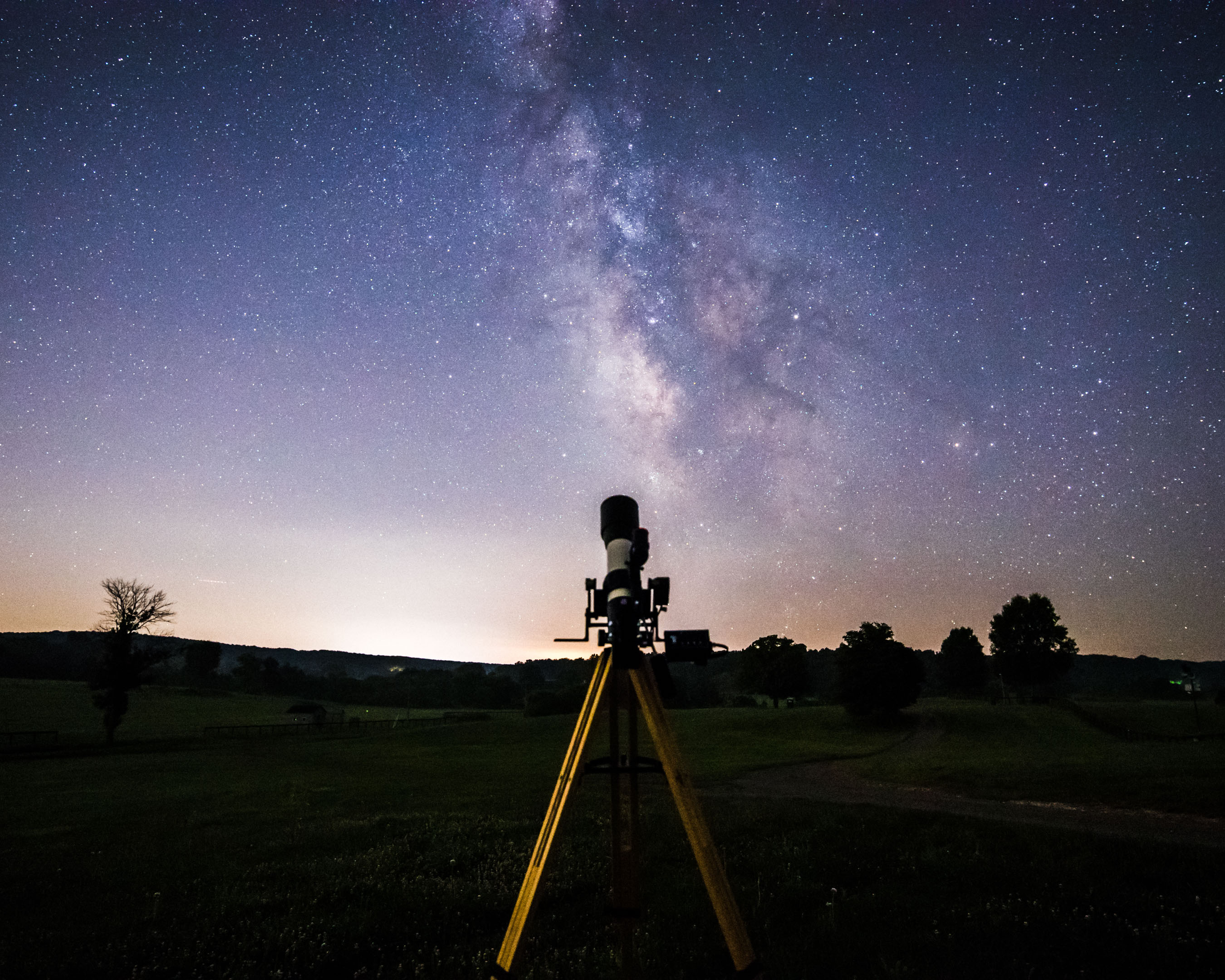
A small telescope faces the Milky Way. Image credit: Brian Ventrudo.

Sometime in 1955, Mr. David Coffeen of New Orleans, Louisiana came up with $75. In today’s currency, that’s about $700, a respectable sum. And what did Mr. Coffeen do with his hard-earned savings?

He purchased a telescope.

Which telescope? A Unitron altazimuth refractor with an aperture of just 40mm, less than that of most finder scopes today. It came with three eyepieces, a star diagonal, and a wooden storage case, because it was an honest astronomical instrument.

Mr. Coffeen used his telescope from atop his modest trailer home. There was a lot to see with that 40mm scope: loads of lunar detail, the rings of Saturn, the Galilean moons of Jupiter and a couple of belts, hundreds of double stars, many of the Messier objects, and a lot more [Read more…] about An Ode to Small Telescopes

Share This:
Facebooktwitterredditpinterestlinkedinmail

Filed Under: Astronomy Equipment

Faint Fuzzies in and Around Pegasus and Andromeda

December 23, 2019 by Joe Bergeron Filed Under: Deep Sky

The globular cluster M15 in the constellation Pegasus.
Image credit: Joe Bergeron.

I write this in late October. Every night, the sky is four minutes more wintry than it was the night before. For now, the sky is still dominated by the constellations most associated with Autumn, even as the Summer Triangle slides past the meridian and the Pleiades rise in the east.

The constellations of northern autumn, Pegasus and Andromeda, linger well into the winter months and offer many deep sky wonders for observers equipped with a good telescope. One recent autumn evening, as the Pleiades rose in the east, I set about looking for a handful of these sights in my 8-inch Edge HD Schmidt-Cassegrain telescope [Read more…] about Faint Fuzzies in and Around Pegasus and Andromeda

Share This:
Facebooktwitterredditpinterestlinkedinmail

Filed Under: Deep Sky

A Low-Power Romp in the Late-Summer Sky

September 13, 2019 by Joe Bergeron Filed Under: Deep Sky

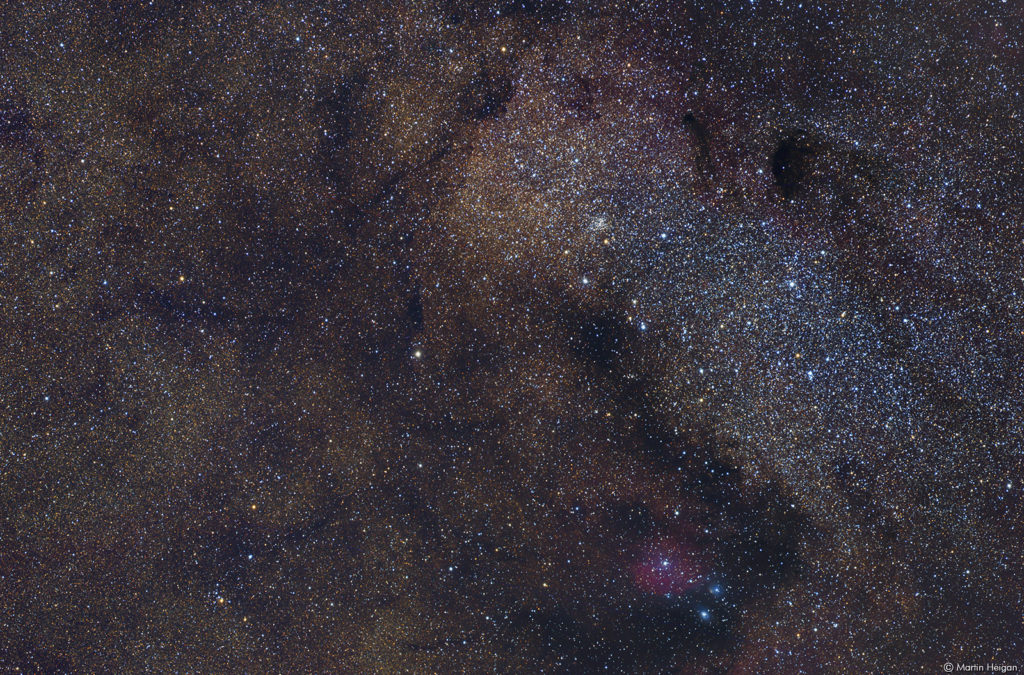
Messier 24, the Small Sagittarius Star Cloud, at right. Image credit: Martin Heigen/Flickr.

Let’s follow last week’s sky tour with a pair of objects where low power is so essential that without it, you might miss them entirely. The first is the open cluster IC 4665, which lies a degree or two north of the star Beta Ophiuchi (Cebalrai). The cluster was “discovered” by astronomer after astronomer, but it didn’t make enough of an impression on anyone to stick around in the astronomical consciousness until it was finally added to the Index Catalog in 1908. In my little telescope at 18x I see a very scattered group of twenty or so easily seen stars spreading across a degree or more of sky. Try as I might, I could not imagine a compelling picture in this random assortment of star dots. Surrounding the most nearly crowded part of the cluster are a few more isolated pairs and individual stars that give the impression of being cluster members. This might be a better object for binoculars than for any telescope. [Read more…] about A Low-Power Romp in the Late-Summer Sky

Share This:
Facebooktwitterredditpinterestlinkedinmail

Filed Under: Deep Sky

Deep Sky Tour: Nebulae in Cygnus

September 7, 2019 by Joe Bergeron Filed Under: Deep Sky

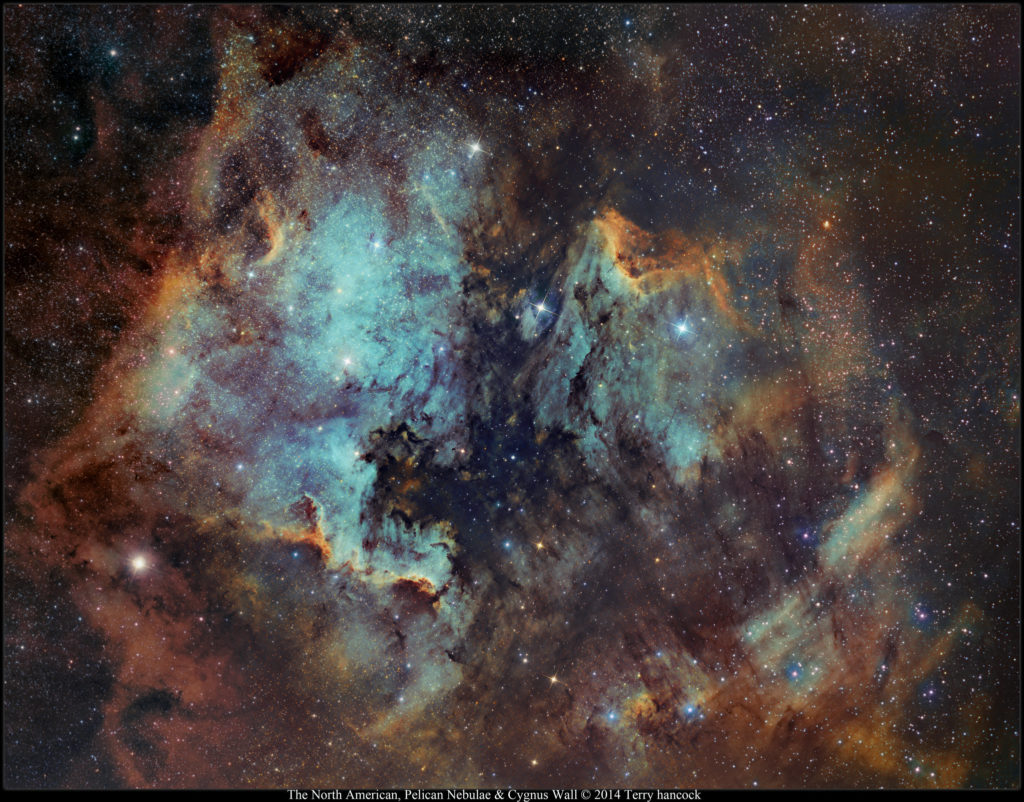
The North America Nebula (left) and the Pelican Nebula (right). Image credit: Terry Hancock via Flickr.

In my previous sky tour, I talked up the virtues of observing deep sky objects using fairly high magnifications with a reasonably big 8-inch f/10 telescope. This time around, let’s veer to the opposite extreme and take a tour of a series of celestial objects that are best seen using small telescopes, low magnifications, and wide fields of view.

Cygnus, the Swan, which is as emblematic of northern-hemisphere summer as any other constellation, holds two of the best examples of wide-field objects which are visible nearly overhead in late northern summer, and low over the northern horizon for southern-hemisphere observers [Read more…] about Deep Sky Tour: Nebulae in Cygnus

Share This:
Facebooktwitterredditpinterestlinkedinmail

Filed Under: Deep Sky cygnus, veil nebula

  • Go to page 1
  • Go to page 2
  • Go to page 3
  • Go to Next Page »

Primary Sidebar

Subscribe to Cosmic Pursuits

Subscribe to our e-mail newsletter for free astronomy tips and updates

Featured Astronomy Course


Search This Site

Recent Posts

  • Noctilucent Clouds – Marvels of the Mesosphere
  • Hopping Galaxies in the Bear’s Den
  • A Dazzling New View of the Sombrero Galaxy
  • NEAF 2026 Overview and Recap
  • If You Could Have Only One Reflector…

Copyright © 2026 Mintaka Publishing Inc.