• Skip to primary navigation
  • Skip to main content
  • Skip to primary sidebar

Cosmic Pursuits

Basic astronomy and night sky information

  • Subscribe
  • Start Here
  • Articles
  • Sky This Month
  • Courses
  • About
  • Contact

Brian Ventrudo

Touring the M81 Galaxy Group

June 27, 2022 by Brian Ventrudo Filed Under: Deep Sky

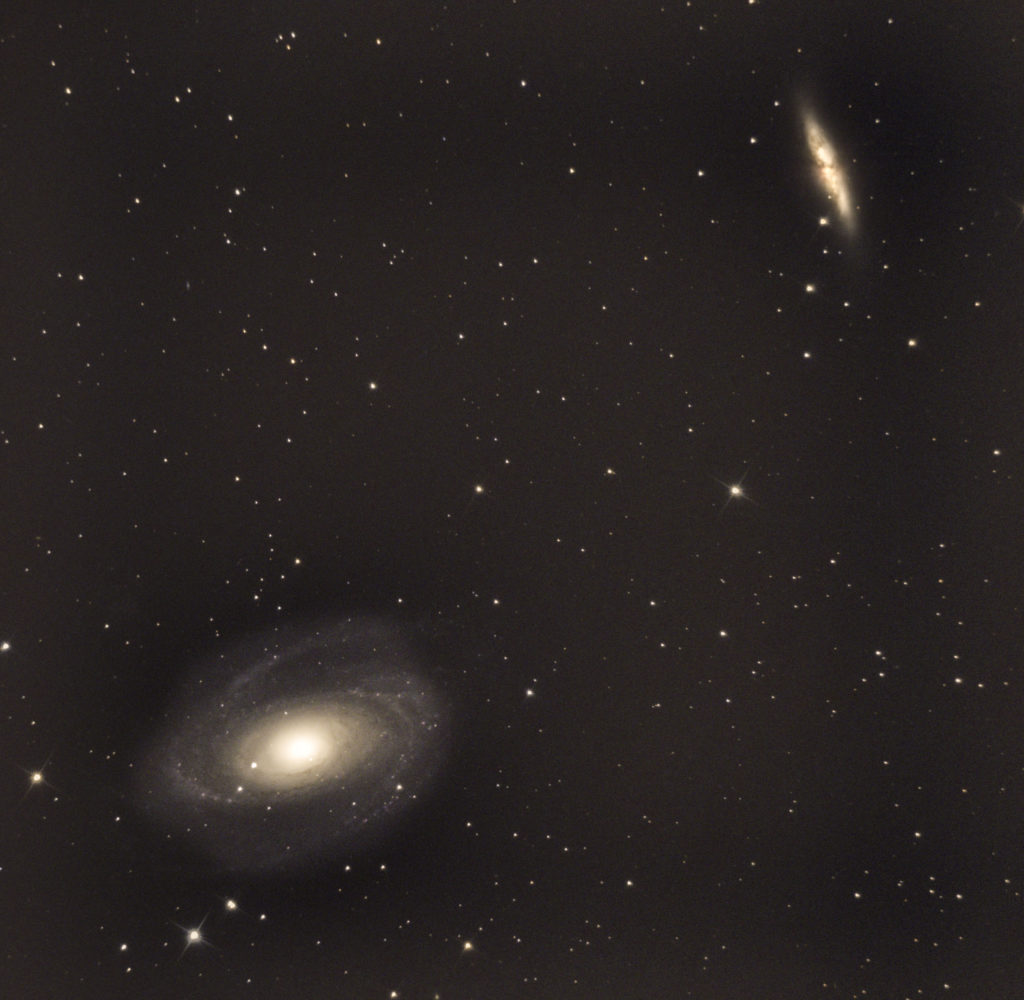
Messier 81 (bottom left) and Messier 82 (upper right).

At a distance of about 11 million light years, the Messier 81 (M81) galaxy group lies nearly overhead in the late northern spring and early summer and presents a handful of intriguing targets for backyard stargazers. This aggregation of gravitationally bound galaxies lies mostly in Ursa Major with some spillover into Camelopardalis. It’s one of the nearest galaxy groups to our own, and it contains some 40 galaxies and a total of about a trillion stars [Read more…] about Touring the M81 Galaxy Group

Share This:
Facebooktwitterredditpinterestlinkedinmail

Filed Under: Deep Sky m81, m82

The Sun Awakens

May 27, 2022 by Brian Ventrudo Filed Under: Solar System

An image of the Sun captured with an H-alpha solar telescope on May 22, 2022. Prominences and filaments are visible on the right edge of the solar disk. Sunspot groups are visible in the lower center and lower right part of the image. Image credit: Brian Ventrudo.

Solar observers haven’t had much to see on and around the Sun in the past several years. But that’s starting to change as our home star begins to show signs of activity in the form of increasing sunspot numbers and other dynamic features as a new solar cycle – number 25 – gets underway.

So, what’s a solar cycle? [Read more…] about The Sun Awakens

Share This:
Facebooktwitterredditpinterestlinkedinmail

Filed Under: Solar System solar

A Deep-Sky Tour of the ‘Hunting Dogs’

April 27, 2022 by Brian Ventrudo Filed Under: Deep Sky

Canes Venatici represented in an 1825 star chart from Urania’s Mirror. Credit: Wikipedia Commons/Library of Congress

Just under the handle of the Big Dipper lies the dim constellation Canes Venatici, the Hunting Dogs, one of ten star groups devised by the 17th century astronomer Johannes Hevelius. Serving as the mayor of Danzig by day, Hevelius, understandably, preferred astronomy to politics and worked diligently to map the Moon, observe sunspots, and modernize maps of the northern night sky. In devising this constellation, he took into account past astronomical references to the two stars south of the Dipper’s handle as “hunting dogs” held on a leash by the huntsman represented by the constellation Bootes as they snapped at the hindquarters of the great bear of Ursa Major.

The brighter of the two stars in this dim constellation is 3rd-magnitude Alpha Canes Venaticorum, more informally called Cor Caroli, the ‘Heart of Charles’. The star was named after Charles I, the unfortunate monarch caught in the buzz saw of the English Civil War and beheaded in 1649. The fainter is 4th-magnitude Beta Canes Venaticorum, also known as Chara. As for the rest of the constellation, it isn’t much to look at. Like the adjacent Coma Berenices, few bright stars lie here because we’re looking in a direction out of the plane of the Milky Way and into intergalactic space. But there are plenty of galaxies here, and a couple of other deep-sky objects of note for backyard stargazers. Let’s take a short tour of a handful of highlights in this little constellation. [Read more…] about A Deep-Sky Tour of the ‘Hunting Dogs’

Share This:
Facebooktwitterredditpinterestlinkedinmail

Filed Under: Deep Sky

The Star Clusters of Cancer

March 26, 2022 by Brian Ventrudo Filed Under: Deep Sky

The Beehive star cluster, Messier 44, also known at the Praesepe.

Nearly overhead in the mid-evening hours of northern spring (and low over the northern horizon in the southern hemisphere), the constellation Cancer is the faintest of the twelve constellations of the zodiac. Many casual stargazers pass it by when looking from bright Gemini to the striking group Leo to the east. In city skies, the constellation is hard to see at all. Despite its inconspicuousness, there are some excellent sights in Cancer within reach of a telescope, including the superb star cluster M44, the Beehive Cluster, and the intriguing M67, one of the oldest known open star clusters. [Read more…] about The Star Clusters of Cancer

Share This:
Facebooktwitterredditpinterestlinkedinmail

Filed Under: Deep Sky

Small Telescope Tour of the Winter Stars

December 30, 2021 by Brian Ventrudo Filed Under: Deep Sky

If you’re looking for something good to see in the northern-hemisphere winter sky, my recent article at Sky & Telescope magazine will give you plenty of ideas. From the star clusters of Perseus down to the rich fields of Canis Major and Puppis, this tour includes a couple of dozen deep-sky sights and collections of sights that look better in a small telescope than in a big one.

You can access a PDF of the article at this link.

And, in the video below, I walk through the article with Dr. Frank Timmes of the University of Arizona as part of the American Astronomical Society’s video series. Take some ideas from this article, dress warmly, and head outside your your scope!

[Read more…] about Small Telescope Tour of the Winter Stars

Share This:
Facebooktwitterredditpinterestlinkedinmail

Filed Under: Deep Sky

  • « Go to Previous Page
  • Go to page 1
  • Interim pages omitted …
  • Go to page 10
  • Go to page 11
  • Go to page 12
  • Go to page 13
  • Go to page 14
  • Interim pages omitted …
  • Go to page 79
  • Go to Next Page »

Primary Sidebar

Subscribe to Cosmic Pursuits

Subscribe to our e-mail newsletter for free astronomy tips and updates

Featured Astronomy Course


Search This Site

Recent Posts

  • Noctilucent Clouds – Marvels of the Mesosphere
  • Hopping Galaxies in the Bear’s Den
  • A Dazzling New View of the Sombrero Galaxy
  • NEAF 2026 Overview and Recap
  • If You Could Have Only One Reflector…

Copyright © 2026 Mintaka Publishing Inc.