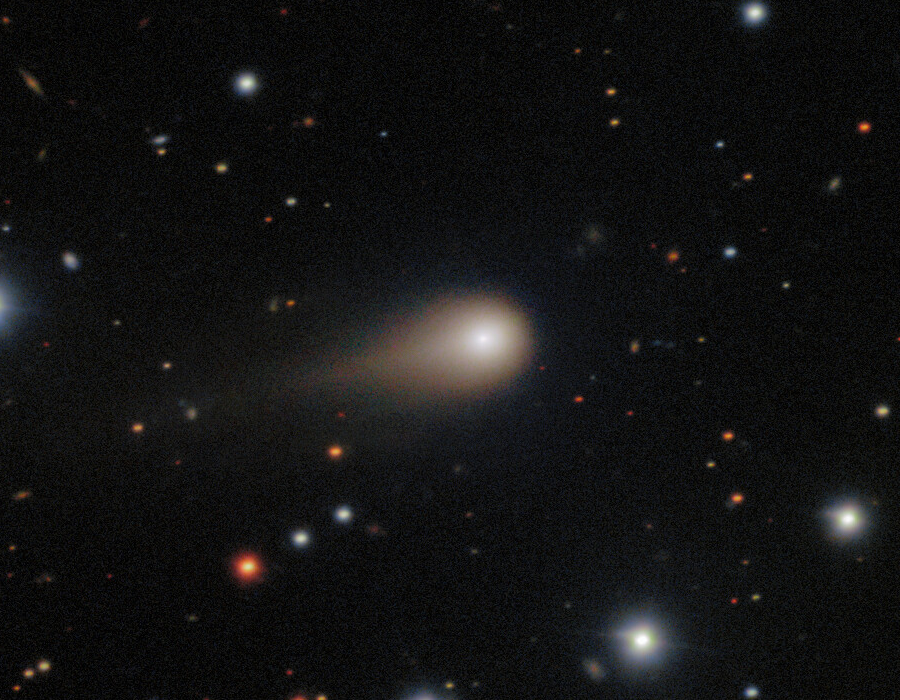
It’s a comet! No, it’s an alien spaceship! No, it’s probably just a comet. But Comet 3/I ATLAS isn’t just any comet. This speedy little visitor, which was discovered by the ATLAS survey telescope near Río Hurtado, Chile, on July 1, 2025, is only the third confirmed interstellar comet or asteroid ever observed in our cosmic neighborhood. It’s a free ‘sample delivery mission’ from another star system, and it may help reveal secrets and insights about the nature and composition of other stars and planets in the Milky Way.
What makes astronomers sure that 3I/ATLAS comes from interstellar space? The answer lies in its trajectory and speed. The comet follows a hyperbolic orbit with an eccentricity of 6.14 — the highest of any interstellar object yet discovered. That means it’s travelling through our solar system in nearly straight line, and at roughly 221,000 kilometers per hour, or about 61 km/s relative to the Sun at the time of its discovery. This speed is nearly 500 times higher than the solar system’s escape velocity. So once this interstellar interloper passes through, it’s not coming back this way again. No gravitational interaction with the Sun or planets could have accelerated the comet to such speeds, so astronomers conclude it does not originate in the Oort Cloud or Kuiper Belt like most comets. When astronomers calculated its path back in time, they found 3I/ATLAS originated from interstellar space, likely from the direction of the constellation Sagittarius near the Milky Way’s galactic center.
Unlike the previous two interstellar visitors — the enigmatic ‘Oumuamua in 2017 and comet 2I/Borisov in 2019 — this newcomer appears to have journeyed from the galaxy’s thick disk, a region populated by stars formed during the Milky Way’s youth. Early estimates suggest 3I/ATLAS may be between 7 and 10 billion years old, older than our entire solar system. If true, this frozen relic was already ancient when the planets around our Sun were still coalescing from a disk of gas and dust.
An Unusual Chemistry
Upon inspection by the big orbiting and terrestrial scopes, astronomers found some surprising results. The James Webb Space Telescope detected an unusually high concentration of carbon dioxide ice in the comet’s coma — the cloud of gas and dust that surrounds its nucleus as it heats up approaching the Sun. The carbon dioxide-to-water ice ratio measured at 8:1, among the highest ever recorded for any comet. This composition is dramatically different from most solar system comets, which typically contain more water ice relative to carbon dioxide. The finding suggests 3I/ATLAS formed in a planetary system where conditions differed substantially from those in the outer reaches of our own solar system. Perhaps its parent star system was richer in carbon dioxide, or perhaps radiation processes stripped away other volatile compounds, leaving the comet enriched in this particular ice.
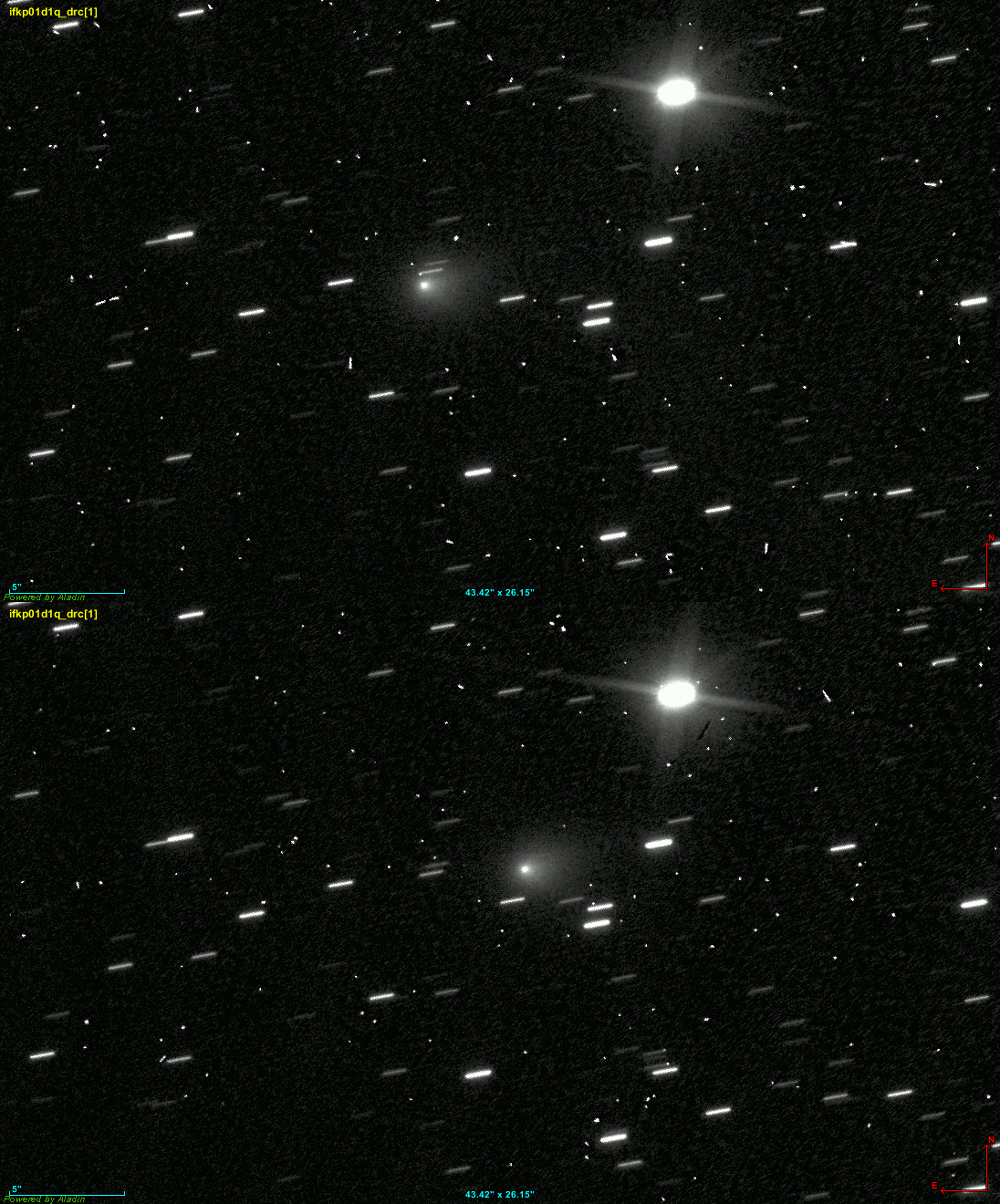
Hubble Space Telescope observations revealed another curiosity: the comet displayed higher polarization than typical solar system comets, a feature it shares only with Hale-Bopp, the spectacular Oort Cloud comet which astronomers believe approached the Sun for the first time in 1996-97. This similarity suggests that 3I/ATLAS might be a pristine object, one that has never ventured close to a star before.
Comet 3I/ATLAS also began producing its coma unusually early — outside the orbit of Jupiter, at a distance where most comets remain dormant. This early activity likely results from carbon dioxide ice sublimating at greater distances from the Sun than water ice, confirming the comet’s unusual chemical makeup. The comet also contains plenty of water: measurements show traces of OH molecules, a signature of water disassociated by the solar UV light, when the comet was about 3 astronomical units (AU) from the sun. At that distance, water ice does not usually turn into gas. So perhaps the water was dredged-up ice grains from inside the comet’s nucleus as the more abundant carbon dioxide and carbon monoxide outgassed into space.
When and Where to See Comet 3I/ATLAS
The comet was observable from Earth until late September and lost in the sun’s glare since then. It was observed and imaged by cameras on the Mars rover and more recently by the NASA SOHO solar research satellite and other satellites. It reached perihelion on October 29, 2025 at a distance of 1.36 astronomical units (AU) from the sun, roughly between the orbits of Earth and Mars. A study submitted to Astrophysical Journal Letters show the comet brightened suddenly and unexpectedly by at least 2 magnitudes at perihelion for as-yet unknown reasons. So when it swings around the Sun, it may offer a more promising target for telescopes if it remains shining at its present brightness of near 9th magnitude.
In November, the comet will again become visible from Earth for telescope observers. By early November, 3I/ATLAS emerges into the pre-dawn sky, visible low on the eastern horizon before sunrise in the constellation Virgo, near the bright star Spica and the planet Venus. Throughout November and December 2025, the comet will be observable from both northern and southern hemispheres as it moves through Virgo and into Leo. On Nov. 18-19, it passes 1.5° south of the 3rd-magnitude star γ Virginis (Porrima).

You need a telescope with at least 3 to 4 inches of aperture to observe this interstellar comet. Its closest approach to Earth occurs on December 19, 2025, at a distance of 1.8 AU, close enough for detailed study by the big professional scopes. After that, it will gradually fade as it heads back toward interstellar space, passing Jupiter’s orbit in March 2026 before disappearing into the deep sky forever.
Ancient Ice – Or Alien Technology?
But is 3I/ATLAS really a comet, or is it a spaceship from an extraterrestrial civilization on a mission to study our solar system? Harvard astronomer Avi Loeb, known for his provocative suggestions about previous interstellar objects, co-authored a paper suggesting that remote possibility. Loeb and his colleagues, for example, noted several “anomalies”: the comet’s trajectory carries it unusually close to Venus, Mars, and Jupiter; it moves nearly along the ecliptic plane where Earth and most planets orbit; and it will pass behind the Sun during perihelion, where it could theoretically execute a braking maneuver unobserved from Earth.
Loeb himself emphasized the exercise was largely pedagogical, estimating at first only a 30% to 40%(!!) likelihood of non-natural origin. NASA scientists pointed out that 3I/ATLAS “looks like a comet, does comet things, and very, very strongly resembles the comets that we know.” Spectroscopic observations detected familiar cometary molecules — carbon dioxide, water, carbon monoxide, hydrogen cyanide — all consistent with a natural icy body. The comet displays a visible coma and dust tail. No radio signals emanate from it. No course corrections have been observed. While the alien spacecraft hypothesis makes for entertaining speculation, the evidence overwhelmingly supports the simpler explanation: 3I/ATLAS is a natural comet, likely ejected from another planetary system during its formation when giant planets gravitationally scattered smaller bodies into interstellar space. Loeb more recently conceded the chances the comet is really a spacecraft is quite remote, but he argues for keeping an open mind when analyzing these interstellar objects.
A Messenger from Deep Time
If 3I/ATLAS is a spaceship, well, that’s one thing. But as a natural object, the comet offers many scientifically valuable insights. Its ancient ice preserves a chemical record of conditions in another star system billions of years ago, offering astronomers a rare opportunity to test models of how planetary systems form in different regions of the galaxy. By comparing its composition to solar system comets, researchers can begin to answer fundamental questions: Is our solar system typical or unusual? Do different regions of the Milky Way produce chemically distinct comets? What does this tell us about the diversity of planetary formation across the galaxy?
While we’ve only found three interstellar comets so far, it’s likely interstellar space holds trillions of such objects ejected from other planetary systems during their chaotic youth. This makes them frozen time capsules carrying the chemical signatures of long-dead stellar nurseries. We happen to live in a period when our technology has finally advanced enough to detect these wanderers and study them briefly as they pass.
The comet will be observable for only a few more months before it fades beyond detection. If you have a telescope, this November and December offer a rare chance to glimpse a visitor truly from beyond, a relic carrying the dust of stars that shone when the universe was less than half its current age. And whether you observe it yourself or simply ponder its journey, 3I/ATLAS reminds us that our solar system is not an island but a small neighborhood in a vast and ancient galaxy where matter migrates freely between the stars, carrying stories written in ice and stone across the unimaginable spans of cosmic time.
Share This:


