
Look to the east of mighty Orion and you’ll see the constellation Monoceros, the Unicorn. While its stars are faint, Monoceros holds a small treasure chest of superb deep-sky sights for backyard stargazers. Perhaps the most striking is the Rosette Nebula, an achingly beautiful blossom of glowing gas and dust where new stars are forming. The Rosette is an immense nebula, some three times larger than the Orion Nebula and three times farther away. As you see in the image above, captured with a little ZWO smart telescope, the nebula overlaps the star cluster NGC 2244 which formed within the nebula and blown a bubble to give us a look inside. While can be a challenge to see the Rosette visually, even in large telescopes, the nebula is an excellent photographic target and the cluster offers a superb sight in binoculars or a telescope.

Look for Monoceros east of Orion and towards the southern horizon if you’re in the northern hemisphere, and almost directly overhead if you’re south of the equator. The nebula and cluster lie 2° east-northeast of epsilon (ε) Monocerotis. You likely won’t see the nebula in binoculars, but the star cluster is easy to see. NGC 2244 is only a million years old, having recently formed inside the nebula. This gaggle of blue stars shines at magnitude 4.4, so you can see it without optics in dark sky, which is impressive because the stars are some 4,900 light years away. So they must be intrinsically quite bright.
As for the nebula itself, well, it’s quite a bit harder to see. It was discovered piecemeal in the 19th century by observers with large telescope, including a 48-inch reflector. The nebula is therefore cataloged in pieces: NGC 2237, NGC 2238, and NGC 2246. These are all parts of the same star-forming complex, which, because of the non-uniform illumination and sinuous dust lanes, displays an astonishing degree of complexity.
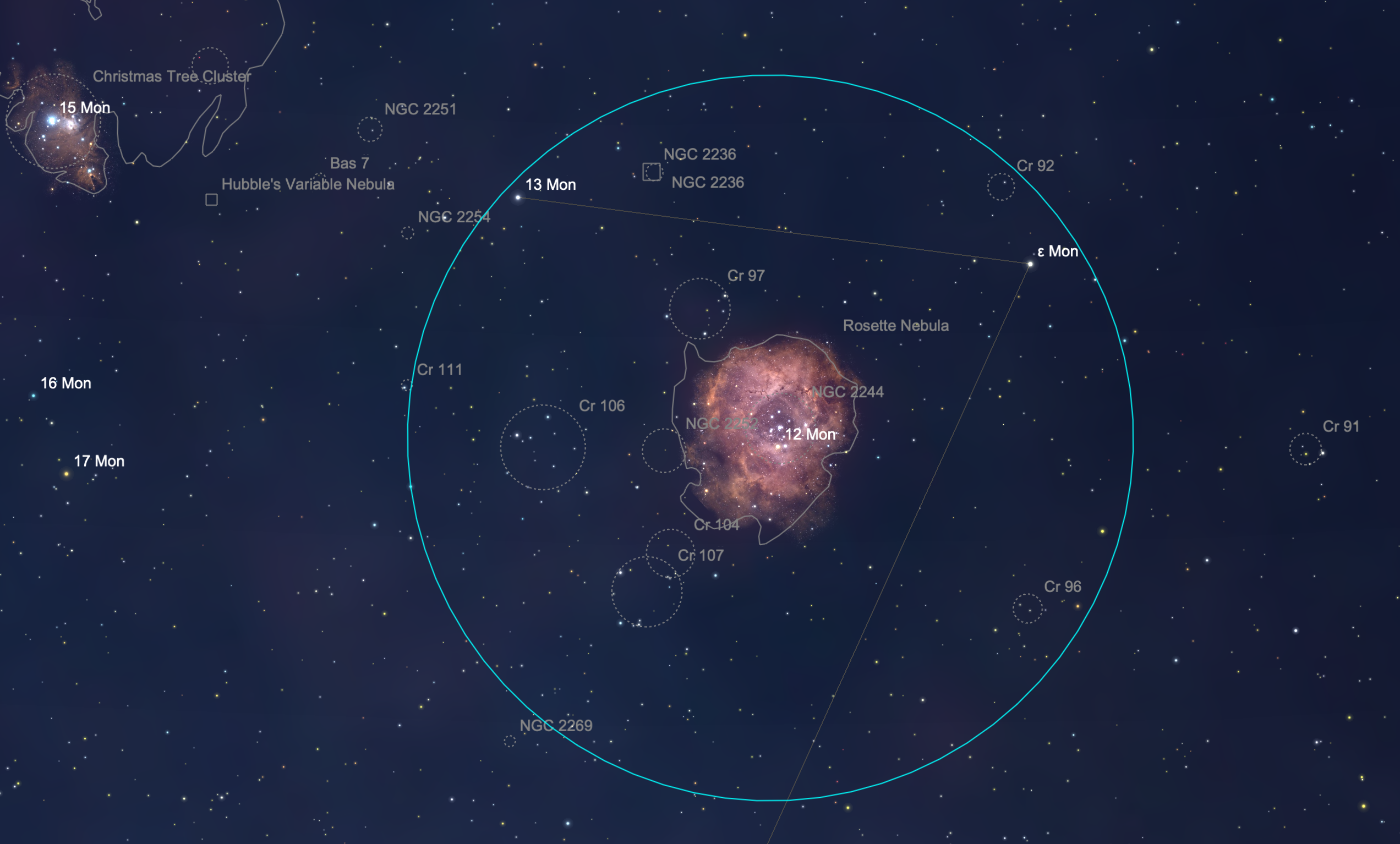
You won’t need a 48-inch scope to see the Rosette. But you will need very clear sky and good relief from light pollution. It’s not an easy object to see. The nebula was barely seen with a 16-inch scope by Ottawa-based amateurs Rolf Meier and Fred Lossing in the 1970’s. Others have spotted it with a 4 or 5-inch scope in excellent sky. Good dark sky is essential to see the Rosette. And make sure your eyes are fully dark adapted. An OIII or UHC filter will help too. I spotted its full circumference and dark interior and cluster with a Tele Vue 85mm refractor at 24mm Panoptic eyepiece with a UHC filter from the exurbs of Washington, D.C. without too much trouble. It was my first night with the telescope and I was so happy with the view of this nebula and the cluster that I wrote Al Nagler with an observing report! Stephen James O’Meara reported seeing it in excellent sky conditions with his unaided eye and in 7×35 binoculars, although he has extraordinary vision.
You can also see plenty of open star clusters around the Rosette within a three degree field (see image above). These clusters include Collinder 97, 104, 106, and 107. None shine as spectacularly as NGC 2244, but they’re all beautiful to behold in your telescope on a dark winter’s night.
Share This:


