“These are the last days of the waning year;
High in the west now stands Deneb,
Great Star of the Cross…”
– Robert Burhnam Jr., Burnham’s Celestial Handbook, vol. 2.
An icy blast of cold and snow landed across the western Canadian prairies this week, but it wasn’t quite cold enough to keep me from having a long last look at the stars of northern summer now fading fast in the western sky. Scanning slowly with a pair of wide-field ‘constellation’ binoculars, I took in the stars of Lyra and Aquila, Delphinus and Sagitta, and the open star cluster IC 4665 near the asterism of Taurus Poniatowski that spells out a contradictory “HI” as it heads below the horizon until spring. But I reserved my final gaze of the evening for one of my favorite patches of sky near the star Deneb at the top of the Northern Cross and the adjacent glow of NGC 7000, the North America Nebula, about 3o to the east.
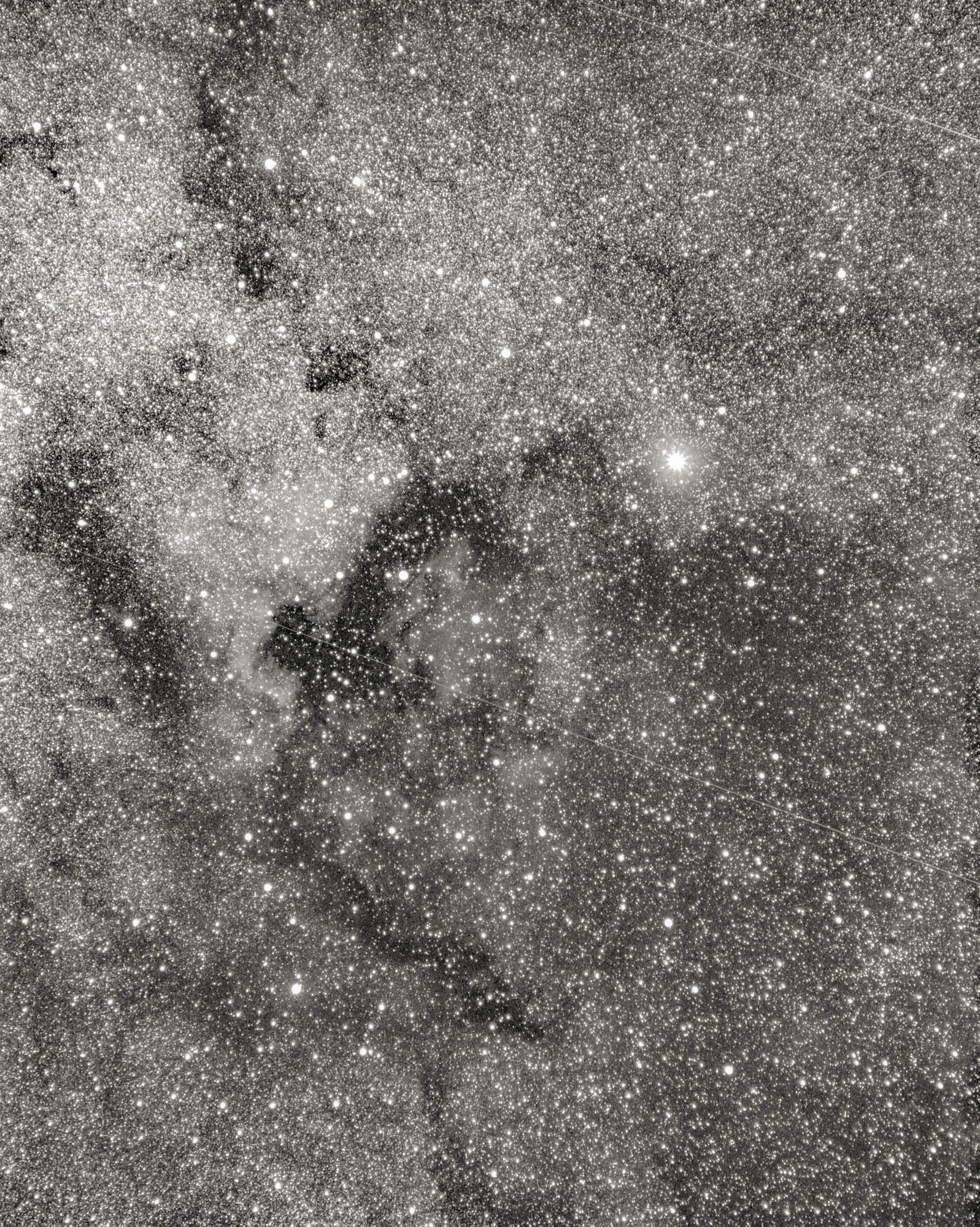
In my modest binoculars, this great nebula appears as a brighter oval patch about 2o wide among the stars of the northern Milky Way. In a telescope with a 4o or wider field of view, the nebula offers hints of its broader structure along with the much fainter IC 5070, the Pelican Nebula about 1.5o to the west with the dark nebula LDN935 between the two. While a visual observer with a small instrument would be hard pressed to discern the eponymous shapes of these two emission nebulae, nearly any image shows these shapes clearly. The North America Nebula (NAN) was first named by German astronomer and pioneering astrophotographer Max Wolf in 1901, although it was first noted by William Herschel as far back as 1786.
Like all emission nebula, the NAN is an immense but simple cloud of cold hydrogen gas excited by ultraviolet light from newly formed stars embedded within and adjacent to the nebula. The UV light from the hot stars, particularly the massive O-type star J205551.25+435224.6, knocks off single electrons from hydrogen atoms leaving a lone proton behind. In time, the ionized electron finds its way back to a proton and cascades to a lower state of energy, emitting light at discrete colors along the way. With our eyes (and cameras) we perceive mostly two colors: blue-green at 486nm (the ‘hydrogen beta’ wavelength) and deep-red at 656nm (the ‘hydrogen alpha’ wavelength).
Deep within the clouds of dust and hydrogen gas in this celestial complex lie compact and dense regions compressed by gravity into new patches of star formation. The most active region of star birth occurs inside the ‘Cygnus Wall’, the bright part of the nebula that resembles the Pacific Coast of ‘Mexico’. This is one of hundreds of similar regions where the galaxy does its business generating new stars from detritus of old stars and heaps of primordial gas left over from the formation of the universe.

I’ve taken many photos even from my light-polluted suburban backyard; modern digital camera and filters that pass the nebula’s light make it relatively easy. During my late-autumn observing session, it was too cold for electronics – or much of anything else. So, I returned inside to contemplate the image at the top of this page captured the ‘old-fashioned way’ – on film – by the photographer James Cormier from a dark-sky location in rural Maine earlier this year. He captured this image of the NAN, Deneb, and the surrounding region with a Pentax 67 medium format film camera and a 400mm Takumar lens at f/5.6. He used the superb (and low-light friendly) Fujifilm Acros II black and white film and tracked the image for 60 minutes, blocking the lens when bright satellites moved through the field of view. Cormier told me he used no filters to suppress lens aberrations or minimize star size, so in this image, bright stars appear bigger. And unlike digital processing, there was no easy way to reduce the number of stars in the final image. Which is OK with me – I like stars. And there are stars aplenty in this field along the Milky Way, especially in the star cloud at the upper left above the nebula.
Film astrophotography lies beyond my grasp – absolutely dark sky is essential, and I don’t have it. But it’s fun to contemplate the ‘analog’ nature of images like this and the process of forming the image of the nebula above.
As in all film photography, images are formed when light hits the silver halide crystal suspended in an emulsion on cellulose film and triggers a photochemical reaction in which tiny, invisible cluster of metallic silver atoms form on the crystal’s surface. This invisible change is called the “latent image”. Developing the film removes the unexposed silver halide and leaves a true image behind.
To form Cormier’s image of the nebula, a remarkable series of events had to unfold: some 2,600 years ago, ultraviolet light from a blazing-hot star collided with hydrogen atoms in an interstellar cloud and ejected electrons from their lone protons. Eventually, the electrons recombined with wandering protons, releasing energy as light which travels 2600 light years to Earth, through our thick and churning atmosphere, and fell into a camera lens and onto a sheet of silver-coated cellulose to trigger a reaction with silver atoms which themselves were formed by exploding supernovae or in merging neutron stars billions of years ago.
It boggles the mind.
Or, as Cormier says more succinctly:
“A long exposure film astrophotograph is an astronomical image formed on silver emulsion. The resulting image is nothing less than starlight embedded in cellulose, itself made from star stuff. Imaging this way makes one more akin to a poet or artist. There’s a romantic aspect to the craft.”
As film astrophotographers from decades past know well, film emulsions grow more sensitive at cold temperatures. But the human body does not like the cold, so after my brief observing session of the outgoing summer stars, I headed back in for the evening. Orion was big and bright in the southeast, but it will have to wait for another night.
Share This:


