
(Looking for last month’s ‘Night Sky’? Find it at this link…)
Comet C/2025 A6 (Lemmon) continues to skirt the western horizon after sunset and challenge astrophotographers trying to tease out detail in its magnificent and complex tail. Visual stargazers can see the comet’s head – barely – without optics in dark sky as November begins. Binoculars reveal a short, ethereal tail. November has lots more in store including a pair of meteor showers and planetary conjunctions along with the regular appearance of galaxy-rich constellations such as Pegasus, Andromeda, and Sculptor. Orion rises well into the evening and dominates the southern sky after midnight. Saturn remains in the sky, still in a good position for viewing, while the orbits of Mars and Venus direct them towards the Sun in the evening and morning sky, respectively. Here’s what to see in the night sky this month.
1 November 2025. Look to the southeast to see Saturn trailing the waxing gibbous Moon by 5o south of the Circlet of Pisces. Saturn’s rings are again tilted less than a degree to edge-on presenting a rare view in a telescope along with several of the planet’s brightest moons. Our Saturn observing guide helps you get the best view of this unique and beautiful planet which remains in prime position for observing into 2026.

2 Nov. Look to the east-southeast before sunrise to see Venus about 3.5o north of 1st-magnitude Spica low over the horizon. While still bright at magnitude -3.9, Venus is nearly as faint as it ever gets and presents an almost fully-illuminated disk in a telescope as it moves towards conjunction.
5 Nov. Full Moon, 13:19 UT (the Full Hunter or Beaver Moon). This is also the largest full Moon of 2025.
6-12 Nov. The Taurid meteor showers peak this week with the Moon just past full. There are two Taurid showers, the Northern and Southern Taurids, and they both peak in late October through mid-November. They’re sometimes called the Halloween Fireballs. You can see these bright, slow-moving meteors in the northern and southern hemispheres at essentially any time of night. This event usually shows 5-10 meteors an hour.
6 Nov. A fat gibbous Moon lies some 6o east of the Pleiades rising in the east a couple of hours after sunset.
11 Nov. A just-past-halflit Moon lies about 2o north of the Beehive star cluster (M44) in the eastern early-morning sky.
12 Nov. Last Quarter Moon, 05:28 UT

12 Nov. Mercury sits just 1.3o south of Mars low in the west-southwestern sky after sunset among the stars of the ‘claws’ of Scorpius. This is a difficult observation for northern-hemisphere observers, but southern stargazers see the pair further above the horizon during this evening conjunction. Binoculars help extract the planets from the evening twilight. Mercury (mag. +1.1) shines slightly brighter than redder Mars (mag. +1.5). In a telescope, Mercury shows a crescent about 20% illuminated and 9” wide. Mars is less than half as wide and offers no detail at this distance. But it’s worth seeing these two rocky but otherwise completely different worlds sinking together towards the horizon.
13 Nov. Regulus lies about a degree south of the waning crescent Moon in the northeastern sky before sunrise.
17 Nov. The thin crescent Moon sits just over a degree south of Spica in the southeastern sky before sunrise. Venus lies about 20o lower to the east, much closer to the horizon.
17-20 Nov. The Leonid meteor shower has been quiet these past many years and it remains a modest event despite some historical outbursts. The shower occurs as the Earth passes through the path of the periodic Comet 55/P Tempel-Tuttle. A peak of 15 meteors per hour is typical for the Leonids. But nothing’s assured and a few extras may arrive, especially this year as the Earth passes through clumps in the comet’s debris stream. Leonids can appear anywhere in the sky but appear to trace their paths back to a radiant in the ‘Sickle’ of Leo. This year, the moon is nearly new so we have a chance to see both bright and faint meteors in the sky, especially on the night of Nov. 17 (in Europe, Africa, and Australia and New Zealand) and the early morning of Nov. 17th in North America.
20 Nov. New Moon, 06:47 UT
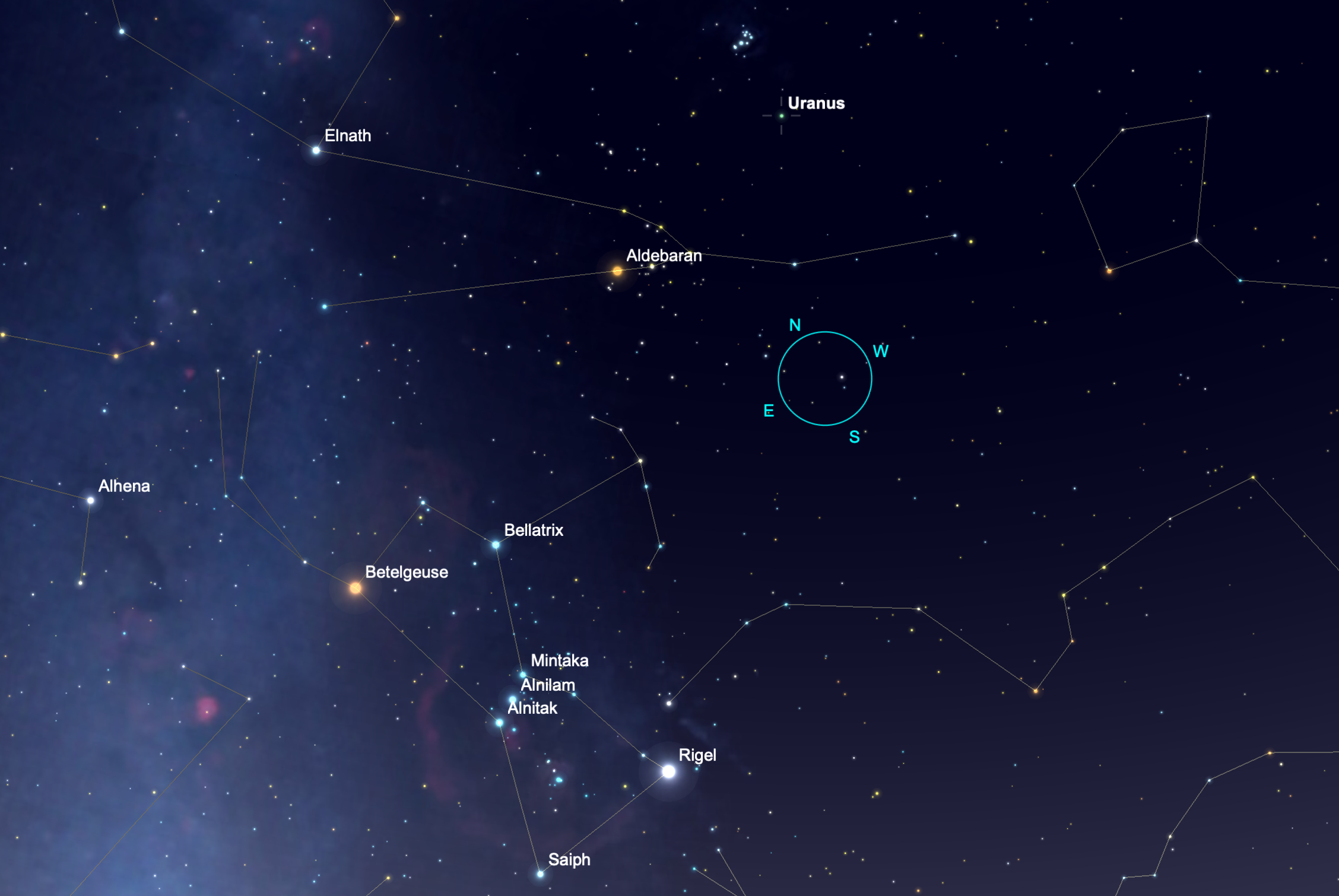
21 Nov. Uranus reaches opposition as it rises in the east as the Sun sets in the west. This distant ice giant lies just at the edge of naked-eye visibility at magnitude +5.7 with a disk that spans about 3.7″. You can see it with binoculars or telescope about 4o south of the Pleiades. Uranus remains visible through the end of 2025 and into the new year in this part of the sky. If you have dark sky, try to see the planet without optics. Although the planet was plainly, though not easily, visible to pre-telescopic stargazers, it wasn’t ‘discovered’ until William Herschel found it with a 6” telescope on March 13, 1781. For an even bigger challenge – try to find some or all of the bright Moons of Uranus with the help of this handy-dandy moon finder at Sky&Telescope.
28 Nov. First Quarter Moon, 06:59 UT
29 Nov. Saturn reaches its second stationary point, ending its retrograde motion and initiating eastward motion against the background stars.