
(Looking for last month’s ‘Night Sky’? Find it at this link…)
March begins with a spectacular total lunar eclipse visible across all of the Americas and Asia including Australia and New Zealand. Venus emerges into the evening sky as Saturn moves out, with the two making a close conjunction on the 8th. And Jupiter remains in prime position for observation from now well into April. Here’s what to see in the night sky this month…
1-2 March 2026. The fattening Moon lies just west of Regulus. The pair move closer together as the night and morning progress and make a close approach in the western sky as dawn arrives.
3 March. Full Moon, 11:38 UT (the full ‘Worm Moon’).
3 March. The full ‘Worm Moon’ falls into a total eclipse for observers in most of the Americas and east Asia. Observers in Asia, including New Zealand and Australia, see the eclipse in the evening while observers in the western hemisphere see it in the early morning. Peak eclipse occurs at 11:34 UT. In the Americas, observers in western Canada and the extreme western U.S. see all of the eclipse; further east, the Moon sets before the eclipse ends, but most of the Americas see the peak eclipse in which the Moon turns coppery-red as it enters the Earth’s shadow. Get the timing for your location at this link.
5-19 March. As the Moon moves out of the way in the evening sky, northern observers far from city lights can again spot the zodiacal light in the western sky after sunset. This whitish wedge-shaped glow emerges at a steep angle to the western horizon this time of year. It’s caused by sunlight reflected by fine dust grains along the plane of the solar system. The zodiacal light is brightest closer to the Sun, so look for it about half an hour after the end of evening twilight as it extends up from the horizon towards the constellation Taurus.
6 March. A fat gibbous Moon lies about 4o west of the star Spica in Virgo.
8 March. Daylight Saving Time begins today (Sunday), setting clocks ahead by one hour in much of North America and making all of us sleepier!
8 March. Get your last look at Saturn this evening. It lies about 1o south of Venus in the western twilight sky after sunset. While it shines at magnitude +1.0, you might need binoculars or a telescope to extract it from the twilight. The planet moves closer to the Sun on the way to conjunction later in March.
10 March. If you’re up early, look towards the southeast to see a nearly last-quarter Moon near the smoldering red-giant star Antares in Scorpius.
11 March. Last Quarter Moon, 09:38 UT
19 March. New Moon, 01:23 UTC.
20 March. The equinox arrives at 14:46 UT as the Sun crosses the celestial equator moving north. This marks the beginning of spring in the northern hemisphere and autumn in the southern hemisphere.
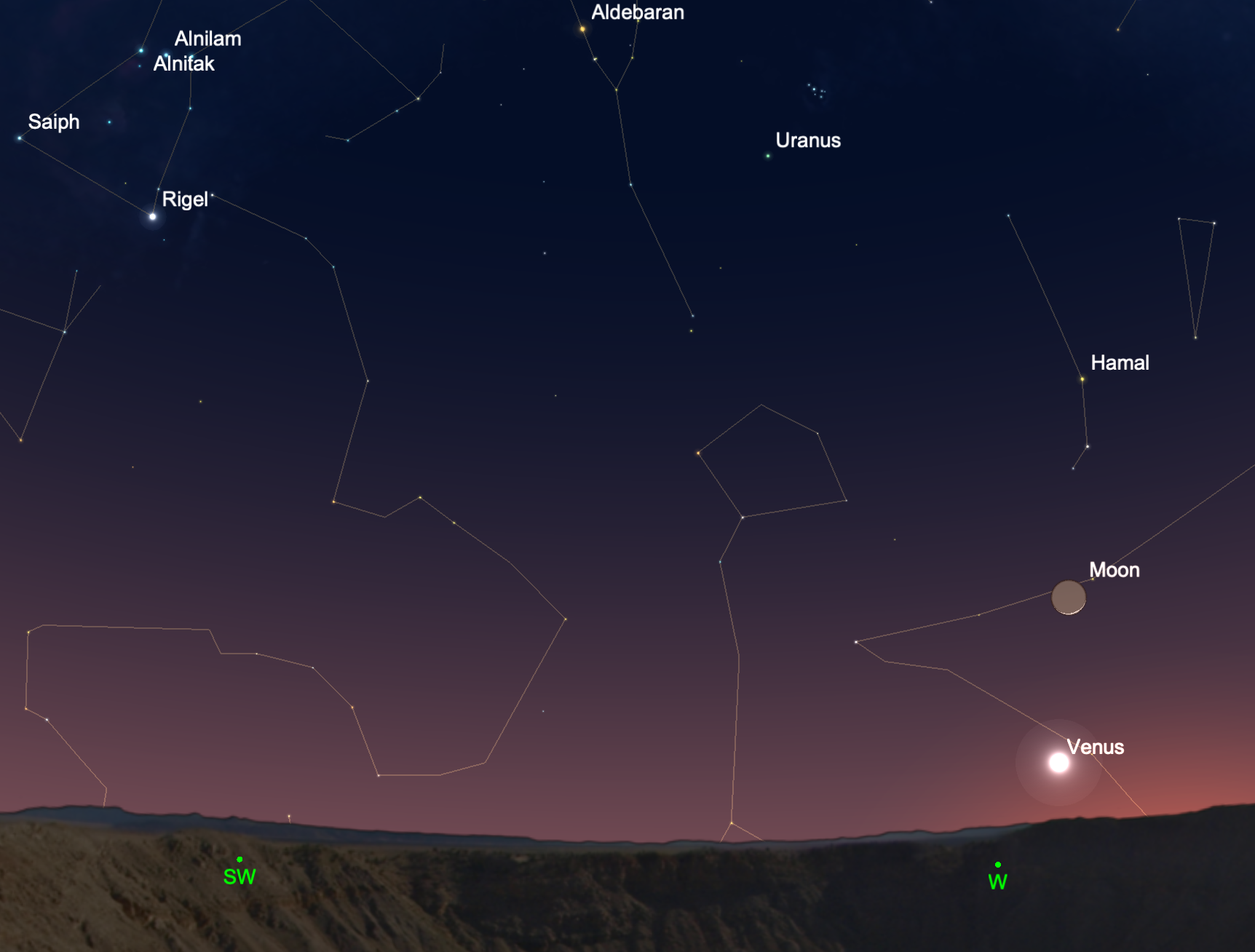
19-20 March. Look for a very thin crescent Moon above Venus in the western sky after sunset. Venus continues to move higher and grow brighter in the western twilight sky from now through September. This month, the planet shines at magnitude -3.9 and in a telescope shows a disk nearly full illuminated and about 10” in diameter.
22 March. The waxing crescent Moon lies about 6o from the Pleiades in the west-northwestern sky after sunset.
25 March. First Quarter Moon, 19:18 UTC

25 March. Look overhead to see the Moon and brilliant Jupiter near the stars Castor and Pollux in Gemini. Jupiter resumed prograde motion on the 11th and now moves eastward against the background stars. The planet remains in a prime position for observation in a telescope, especially for northern-hemisphere observers, and shines at an impressive magnitude -2.4.
25 March. Saturn reaches conjunction with the Sun. It will slowly emerge in the morning sky in the coming weeks.